
Total Knee Replacement: Kinematic Alignment in Little Rock
I have evolved to choosing Kinematic Alignment for my total knee patients.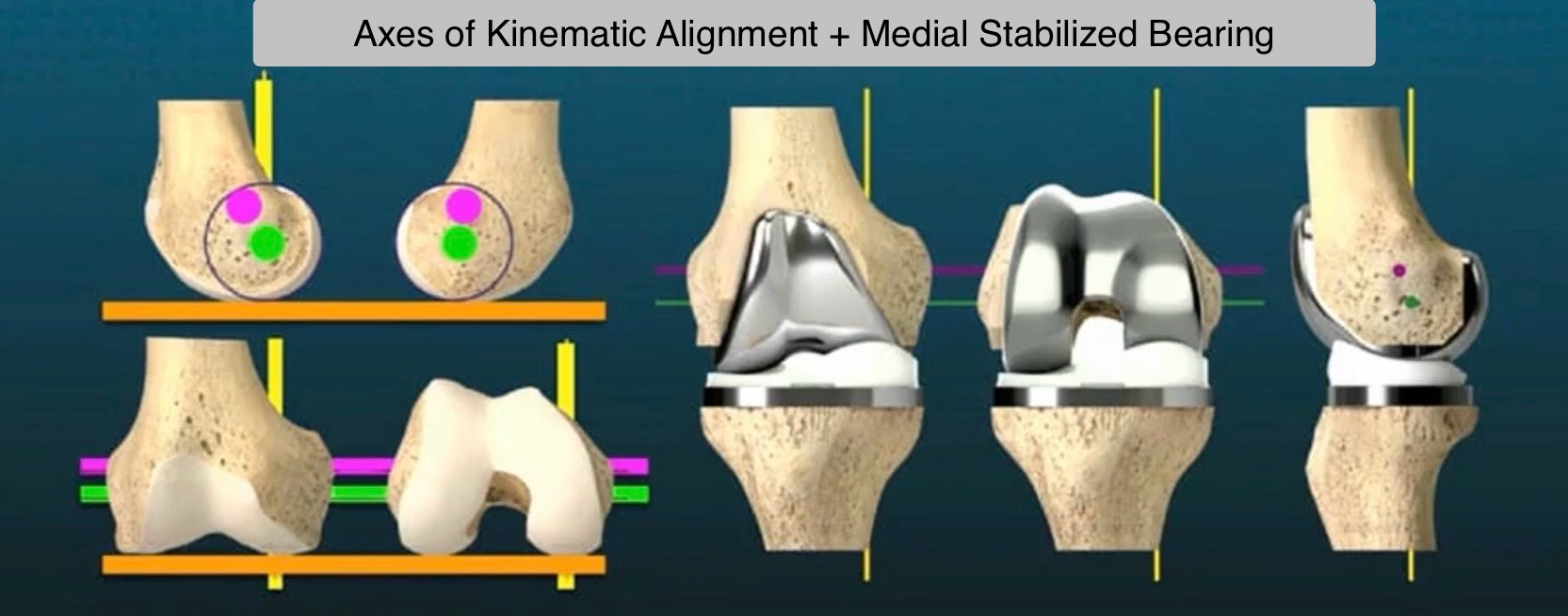
Kinematic alignment is a steadily growing revolution in how total knee replacement is done.
The goal with Kinematic Alignment is to put the new knee replacement back into the position and alignment of the knee before it developed arthritis.
Until recently, the traditional and time–honored alignment method of knee replacement has been Mechanical Alignment. This dictates that the knee joint line is put at a perpendicular to the tibia every time and the femur position is rotated externally on the femur to match the new tibial joint line.
Then additional releases of the ligaments and joint capsule are made to get a snug, but not too-tight balance of the soft tissues.
Anatomic and imaging studies reveal that there are 4 common knee orientations and 2 less common knee orientations. Kinematic Alignment dictates that the new knee replacement is put back into its original knee orientation, rather that forcing it into the single scheme dictated by Mechanical Alignment theory.
By keeping the knee’s original orientation, the knee’s soft tissues are maintained in their lifelong balance, rather than forcing them into less natural twists and stretches which may lead to a less comfortable knee replacement.
More studies are showing that kinematic alignment knees have good, long- lasting durability AND have less pain, more rapid recovery and better Range of Motion than seen with traditional Mechanical alignment.
Furthermore, use of the Robotic Technique or tool to plan and position the knee replacement is not needed because the patient’s own knee alignment and joint position is plainly seen at surgery and after correcting for the worn away cartilage, the pre-arthritic joint alignment and position is in plain view to guide the placement of the prosthesis.
With this method there are rarely any soft tissue releases, and the tissues of the new knee replacement are not asked to stretch and tighten in new and less natural ways as may occur in some Mechanical- Aligned knees.
I believe this leads Kinematic-Aligned knees to have less pain, quicker recovery and better motion.
- Dossett, H.G., Swartz, G.J., Houston, T.K., LeFevre, G.W., & Kwasman, B.G. (2014).
Title: Kinematically aligned total knee replacement results in better function and implant survival than mechanically aligned total knee replacement: A randomized controlled trial.
Journal: Bone Joint J.
Summary: This landmark randomized controlled trial compared kinematic alignment to mechanical alignment (MA) in TKA and found that patients who underwent KA had better functional outcomes and a higher satisfaction rate compared to MA. - Howell, S.M., Papadopoulos, S., Kuznik, K.T., Ghaly, L.R., & Hull, M.L. (2013).
Title: Does varus alignment adversely affect implant survival and function after kinematically aligned total knee arthroplasty?
Journal: J Arthroplasty.
Summary: This study evaluated the long-term outcomes of varus alignment in kinematically aligned TKAs and found that varus alignment did not negatively impact implant survival or function, contrasting with concerns in mechanically aligned knees. - Hopper, R.J., Leach, V., & Rorabeck, C.H. (2014).
Title: Kinematic versus mechanical alignment in total knee arthroplasty: A randomized clinical trial.
Journal: Clin Orthop Relat Res.
Summary: This study directly compared KA and MA techniques and concluded that KA provided superior restoration of knee function and range of motion, particularly in younger and more active patients. - Calliess, T., Ettinger, M., Schofer, M.D., et al. (2017).
Title: Kinematic versus mechanical alignment in total knee arthroplasty: A prospective randomized controlled trial.
Journal: Knee Surg Sports Traumatol Arthrosc.
Summary: This prospective study showed that KA resulted in better early functional outcomes and faster recovery, with patients experiencing a more natural feeling knee compared to MA. - Howell, S.M., & Hull, M.L. (2010).
Title: Kinematic alignment in total knee arthroplasty: Definition, history, principle, surgical technique, and results of an alignment option for TKA.
Journal: Arthropaedia.
Summary: This article laid out the principles of kinematic alignment, the evolution of the technique, and the outcomes of patients who underwent KA. It also presented detailed information about the surgical approach and patient outcomes over time. - Blakeney, W.G., Beaulieu, Y., Puliero, B., et al. (2019).
Title: Functional outcomes and biomechanics following kinematically aligned TKA.
Journal: J Arthroplasty.
Summary: This paper reviewed functional outcomes, gait analysis, and patient-reported outcome measures (PROMs) in patients who underwent KA. It concluded that KA better restored native knee kinematics, particularly in terms of biomechanics. - Nassif, N.A., & Lombardi, A.V. (2020).
Title: Current perspectives on kinematic alignment in total knee arthroplasty.
Journal: Orthop Clin N Am.
Summary: This review article summarized the growing body of evidence supporting KA in TKA and discussed ongoing controversies and potential limitations of the technique. - Young, S.W., Walker, M.L., Bayan, A., et al. (2017).
Title: The Chitranjan Ranawat Award: No difference in 2-year functional outcomes and gait analysis between kinematic and mechanical alignment in TKA.
Journal: Clin Orthop Relat Res.
Summary: In this award-winning study, researchers compared 2-year outcomes between KA and MA, finding no significant difference in function or gait, though some studies argue that longer-term benefits might favor KA. - Rivière, C., Iranpour, F., Auvinet, E., et al. (2017).
Title: Alignment options for total knee arthroplasty: A systematic review.
Journal: Orthop Traumatol Surg Res.
Summary: This systematic review compared various alignment techniques, including KA and MA. It concluded that KA has the potential to offer better functional and kinematic outcomes while reducing implant-related complications in certain patient populations. - Thienpont, E., Schwab, P.E., & Fennema, P. (2014).
Title: Efficacy of kinematic alignment in total knee arthroplasty: A meta-analysis.
Journal: Orthop Traumatol Surg Res.
Summary: This meta-analysis evaluated multiple studies on KA in TKA and reported that KA generally leads to improved patient satisfaction, knee function, and faster recovery compared to MA. - Samuel J MacDessi, William Griffiths-Jones, Ian A Harris, Johan Bellemans, & Darren B Chen (2021).
Title: Coronal Plane Alignment of the Knee (CPAK) classification
Journal: Bone and Joint Journal
Summary: This anatomic study of the knee defines a classification of 9 theoretical and 6 common leg alignment and knee joint line angle combinations and their frequency in the population.